



 French
 English
N e w s
September 2025: Follow our last news on Artenum LinkedIn
You can find the latest news on Artenum and SpaceSuite on the Artenum LinkedIn page:
September 2018: Artenum will attend the ISD 2018 and RADECS 2018 events this month
Artenum will attend the Industry Space Days at ESA/ESTEC in Netherlands the 11th and 12th of September 2018. At this occasion, we will present our latest developments and new SpaceSuite offers.
Our team will also attend the Radiation Effects on Components and Systems (RADECS) conference in Gothenburg, Sweden from the 16th to the 21st of September 2018.
June 2018: Presentation of Artenum's space environment related research activities and developments at the 15th Spacecraft Charging Technology Conference (SCTC 2018) in Japan
Artenum attended the 15th Spacecraft Charging Technology Conference held from the 25th to the 29th of June 2018 at the Integrated Research Center of Kobe University in Japan. This international event focuses on scientific and technological effects related to the interaction between space systems and the surrounding plasma and radiations environment.
Artenum presented a complete internal charging study on the CNES/AMBER instrument currently flying on-board Jason-3. This study rely on the complete chain of SpaceSuite tools to perform radiation and internal charging study: the creation of the radiation-compatible geometric description with EDGE – the GDML editor, the setting and running of ESA/GRAS kernel using the MoORa software and the use of the SPIS-IC software to conduct the internal charging study using the radiations results obtained with MoORa.
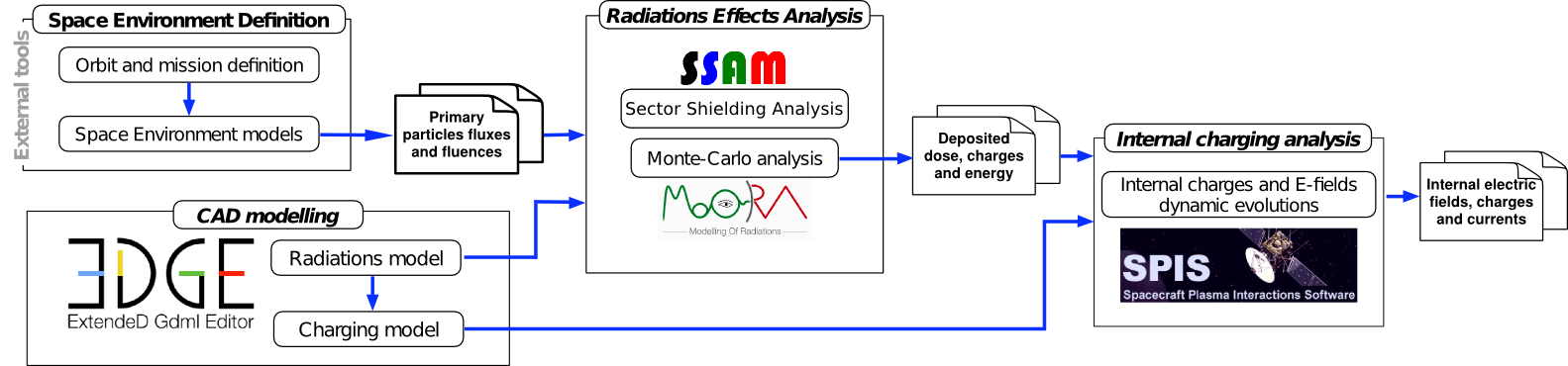
Both EDGE and MoORa tools are available through the SpaceSuite offer and the SPIS-IC software can be obtained via the SPINE community. Global assistance contracts covering the whole modelling chain are available.
January 2018: Latest Artenum communications and launch of the SpaceSuite offer
Artenum and the SPIS-Services team wish you all a very happy new year 2018. This beginning of the year is full of news we wish to share with you:
- Artenum has presented its Integrated Modelling Environment (IME) Keridwen, in a poster during the last Open Source CubeSat Workshop (OSCW) held on the 23rd and 24th of November 2017. This poster is available here [PDF].
- Artenum, in partnership with ONERA, has presented a new integrated pre-processing chain for radiations and internal charging effects analysis on a Raspberry Pi CPU. The radiation analysis has been done with our new software MoORA (Modelling Of RAdiations), allowing the user to drive the numerical code GRAS, developed by ESA and based on the GEANT-4 library. As for the internal charging study, it has been done with SPIS-IC. This work has been exhibited by Artenum during the 14th edition of the European Space Weather Week (ESWW), held from the 27th of November to the 1st of December 2017. The presented poster is available here [PDF].
- Owing to the success of SPIS-Services and due to the evolution of the needs of space industry and research, Artenum and ONERA have created a new partnership called SpaceSuite. This new commercial offer proposes a multi-physics software suite and a pool of scientific expertise, allowing the user to study and model the effects of space environment on a spacecraft. It is providing trainings, assistance contracts and advanced studies in both simple and multi-physics approaches.
SpaceSuite regroups several physical thematic such as radiations, spacecraft charging, multipactor effect... In this frame, please note that the commercial offers of SPIS-Services are integrated into SpaceSuite. The SPIS-Services website as you know it is still available at www.spis-services.eu. - In the frame of this new commercial offer, a new training session entitled "SpaceSuite Radiations and Internal Charging course" will be held on the 26th and 27th of March 2018 at ONERA Toulouse (France). This new training course will focus on the use of SpaceSuite numerical tools to model radiations and internal charging effects inside sensitive components. For more information about the content of this course, please consult the enclosed training program.
Please note that for this training course, an early bird fee will be established. Any registration to this training ordered before the 16th of February 2018 will beneficiate from a 10% discount. Registration will be closed on the 12th of March 2018.
For more information on SpaceSuite, please visit our website www.space-suite.com or contact us at contact [at] space-suite.com in order to receive our DOP (Detailed Offer and Pricing) document.
March 2017: Move of Artenum Toulouse premises
The Artenum team is pleased to announce that following an increase of their staff, Artenum Toulouse has moved on the 17th of March 2017. This new premises are located at 20 rue Hermès 31520 Ramonville St Agne, inside the "Parc Technologique du Canal".
The team is already reachable at this new address and keeps its current phone numbers.
January 2017: Early news for SPIS-Services in 2017
Artenum and all the SPIS-Services team wish you a happy new year 2017. In this beginning of the year, we have several news we wish to communicate to you:
We are pleased to announce the arrival of a new member, Amandine Champlain, who will in charge of SPIS-Services for Artenum. She is a new PhD graduate who studied lunar dust charge and electrostatic transport by developing a new experimental setup and modelling these experiments with SPIS.
New training sessions in the use of SPIS (Spacecraft Plasma Interaction Software) latest version will be held by Artenum and ONERA on the 27th and 28th of March 2017 at ONERA Toulouse (France). For more information about the content of these training courses, please consult our website or feel free to contact us (contact[at]spis-services.eu).
Artenum and ONERA are also currently in the final steps of the development of a new SPIS-Services functionality which enables to configure and launch a radiation numerical core based on Geant4 and use its results to model the internal charging effect on a sensitive spacecraft component. We will keep you posted about the evolution of this new feature.
Feel free to visit the SPIS-Services website for further information or to contact us (mail: contact[at]spis-services.eu) to obtain our Detailed Offer and Pricing (DOP) document.
September 2016: SPIS-Services Fall 2016: Announcement of new services and tools
Artenum and ONERA are proud to announce the updated services offer in spacecraft-plasma interactions, SPIS-Services (see www.spis-services.eu),including new support services, trainings and the access to a newly packaged set of advanced tools, called SPIS-Services Edition Fall 2016-SC applications.
The Spacecraft Plasma Interaction System is an open-source software that has been developed to model spacecraft/plasma interactions, and more particularly spacecraft charging (see www.spis.org).
The SPIS-Services offer proposes, together with the SPIS software, various services of support, including: trainings courses, assistance contracts, advanced studies.
To sustain these offers and follow the evolutions of needs of SPIS users, SPIS-Services proposes the access to SPIS-Services Edition Fall 2016 - SC applications.
SPIS-Services Edition Fall 2016 - SC applications presents various novelties, including the inntegration of the ExtendeD Gdml CAD Editor EDGE, allowing to create or edit GDML files.
Further information are available on the SPIS-Services web site (www.spis-services.eu).
SPIS-Services is operated in partnership by Artenum and Onera.
April 2016: Presentation of Artenum's space environment related research activities and developments at the 14th Spacecraft Charging Technology Conference (SCTC 2016) at ESA-ESTEC, The Netherlands
Artenum attended to the 14th Spacecraft Charging Technology Conference held from April 4 to 8 at the ESA-ESTEC center in The Netherlands. This international event focuses on scientific and technological effects related to the interaction between space systems and the surrounding plasma and radiations environment.
Artenum presented the integration of the ESA/GRAS ESA/GRAS radiation tool into the SPIS-IC software and a new easy-to-use GDML CAD editor, both developments being based on the Keridwen IME.
The GRAS/SPIS-IC integration aims to simplify the analysis of radiations/internal charging effects through coupled simulations inside a common Integrated Modelling Environment (IME). This multi-physics / multi-models approach should allow to address the new scientific and technical challenge of future scientific missions like ESA/Juice and commercial massive satellites constellations.
In the specific field of radiations analysis, reference tools like ESA/GRAS or GEANT-4 require an input geometry description of modeled spacecrafts in the GDML Geometrical Description Markup Language. However, up-to-now there were very few fully operational GDML editors available in the community. In most of the cases, users had to edit the GDML file manually which was very time consuming. To address this issue, Artenum has proposed and developed a fully new WYSIWYG CAD editor for GDML, called EDGE for ExtendeD Gdml Editor.
Both tools are scheduled to be soon available through the SPIS-Services offer.
February 2016: First release of GEFICOT, a simple tool for geo file coherence
Geo file is a geometry file format defined by Gmsh currently used in the SPIS software. A complex geometry description in geo file can be very huge and if there are coherence issues, they can very long to correct. Thus, Artenum has develop a simple tool to correct several issues that people can encounter, such as identifiers conflict or duplicated geometry.
GEFICOT is an open-source project based on the Integrated Modelling Environment (IME) Keridwen. You can find more information and can download it on the GEFICOT Project Page.
October 2015: SPIS-Services: a new support service in spacecraft charging analysis with SPIS
In the frame of an industrial partnership, Artenum and ONERA have recently initiated a new support service, called SPIS-Services, dedicated to the modelling of the interactions between orbital systems and space plasma with SPIS.
SPIS is dedicated to model spacecraft-plasma interactions, including spacecraft charging. Initiated in the 2000's, SPIS became the European reference tools in the field today.
Especially designed to simplify the use of SPIS in industrial and operational contexts, SPIS-Services provides a consistent set of supports through training, assistance contrats and advanced studies.
Technically based on the reference and open-source version of SPIS, SPIS-Services also aim to provide a set of complementary pre and post-processing tools.
You can find more informations on the SPIS-Services website.
June 2011: Presentation of Keridwen at the 16th Web3D Conference
Artenum attended the 16th ACM Web3D Conference, held from June 20 to 22 at the Réfectoire des Cordeliers in Paris.
This international event, sponsored by the Web3D Consortium and organized by Systematic Paris-Région, is an opportunity for researchers, developers, experimenters, artists and content creators to share their knowledge and to review their methods of creating, using and improving new 3D Web and multimedia technologies.
This year, Artenum presented the state of the art of his Keridwen IME and several of its components, including the Cassandra 3D post-processing software and the Penelope / JFreeMesh library for managing non-structured meshes.
April 2011: A new expertise in Toulouse for the CAD
As part of developing its activities around its Integrated Modelling Environment (IME), Keridwen, Artenum has strengthened its expertise in CAD by hiring new talents around the OpenCascade. technology.
The fine integration of OpenCascade in Keridwen and its post-processing tools like Cassandra will allow to strengthen the capabilities of Keridwen in industrial context and coordinate the entire modelling chain, from complex systems geometry to detailed analysis of simulation results.
Open source and based on a strong technological base, Keridwen has everything to become the reference IME solution.
Mars 2011 : Artenum, ten years of scientific open source software!
December 2010: Artenum's continuous integration chain
In the frame of the constant improvement of its products and software services monitoring, Artenum has set up a full continuous integration chain based on today's reference tools (Maven, Hudson, LibreSource, Sonar....). Beyond the development of quality software solutions produced, the objective is to improve their traceability, monitoring and inter- operability.
All Artenum projects are progressively installed on our continuous integration server at http://hudson.artenum.com that automatically builds and tests them. The quality of the code is also automatically checked by our quality management platform at http://sonar.artenum.com. Finally, more and more Artenum projects are deployed on our public Maven repository at http://maven.artenum.com to simplify the re-use of our components in your projects.
October 2010: Artenum sponsorises a sailing boat in the Route du Rhum!
Artenum participates to the sponsorship of the sailing boat L'Express-Sapmer, skipped by the reporter and offshore racer Pierre-Yves Lautrou, for this 9th edition of the Route du Rhum. His ship, the Class 40 Nr. 68, is a high tech mono-hull of 40 feet, smaller sistership of the Vendée Globe machines.
The project is in part funded through an original online sponsoring le Web prend le large which allows every Internet user to buy a communication area on the boat.
The start will be done the 31st of October 2010 at Saint-Malo (French Britanny) to reach Pointe-à-Pitre (Guadeloupe), which corresponds to 3540 nautic miles (about 6500km) of single-handed race with about 80 competitors in 5 classes.
Our crew send their best wishes of success to Pierre-Yves, and may the Artenum's black flag go with him!
October 2010: Release of ArtTk 2.0.1
The graphic library ArtTk is available in version 2.0.1.
Particularly suited to scientific and technical applications, ArtTk offers in its toolkit a set of GUI modules (widgets) to facilitate the assembly of Swing components in a specialized GUI.
In this version, graphic loggers were added to display warning, error, information messages, etc. with a display of icons related to the importance of the message.
Since version 2.0, ArtTk has been enriched with a color gradients editor, which allows to manipulate gradients via graphical interfaces, and GridBagPanels, which are components to simplify the definition of the application's layout.
September 2010: Artenum: a new site at Toulouse (France) for space and GIS activities
Artenum is glad to annonce the opening her new site on the Toulouse area, following the reinforcement of her team.
The pole of Toulouse will be dedicated to the space and aeronautics related activites and the Geographical Information Systems (GIS).
June 2010: Presentation of Collaviz at the Ter@tec Forum
In the frame of the Ter@tec 2010 Forum, held on 15 and 16 June on the campus of the Ecole Polytechnique, Palaiseau (Essonne), the first version of Collaviz, the 3D visualization platform, was publicly presented at the workshop about "the new paradigms of scientific visualization".
Gathering more than sixty major industrial actors and research laboratories, the Ter@tec association was founded at the initiative of the French Atomic Energy Commission (CEA), with the aim to be the first European Competitiveness Center in numerical simulation and high performance computing. The key theme of the Ter@tec 2010 Forum was the increase of the uses of supercomputing and intensive computing in the industry and research. The workshops were an opportunity to present the many collaborative projects related to HPC.
We remind that the objective of Collaviz, a project supported by the ANR, is to facilitate the analysis and the visualization of large scientific data by remote multi-experts. As open source, modular and Service Oriented platform, Collaviz intends to be easily extended to tailored applications and should be understood as a natural evolution of the SCOS/V3D project.
November 2009: A new expertise at Artenum
Artenum is happy and proud to announce that its collaborator Benoît Thiébault, has been awarded his Doctorate in Physics.
His thesis, "3D Modeling of plasma environments of particles emitted by space probes," , submitted November 25, 2009 to LATMOS at the University of Versailles Saint-Quentin, was awarded "very honorable" mention – plus congratulations from the entire Artenum team.
The French-Swedish jury was composed of the best European experts in the field of modeling plasma-satellite interactions.
August 2009: End of the Mongol Rally – Finish line in Ulan Bator
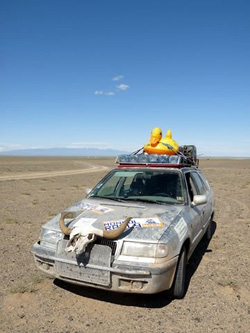
The team, The Frogs go Wildeast have arrived safe and sound in Ulan Bator. With its rear axle severely damaged, the Skoda Felicia would have lived its last moments on the course 500 kilometers from the capital, if it had not been for the ingenuity and spirit of collaborative aid of the local mechanics.
After a breakfast washed down with café au lait in the French restaurant in Ulan Bator, the four team members went to the Ger Village established by the Christina Noble Children's Foundation, with whom they had decided to compete.
This organization has three priorities for its work in Mongolia:
– provide a home to the poorest through its program, Give a ger,
– scare for the most disadvantaged,
– help organize the Ger Villages for the benefit of the children.
In Ulan Bator alone, more than 4000 children live on the street in extremely harsh conditions.
A moving report with many photos on the blog of the Frogs mongolnautes concludes this adventure.
July 2009: >Artenum sponsors a team of the Mongol Rally!
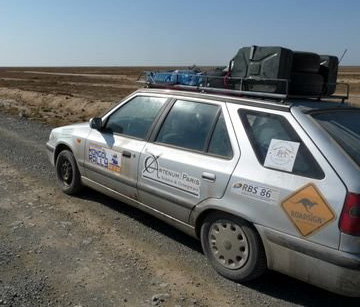 Artenum is pleased to announce her sponsoring to the The Frogs go WildEast team participating to the 2009 edition of the Mongol Rally. The team left Saturday the 18th July 2009 from Milan aboard a customised Skoda Felitia, and should arrive in Ulan Bator late August. The selected north route will pass through Ukraine, Central Asia and Russia.
The Mongol Rally is a charity rally that starts from London, Milan and Madrid to reach the capital of Mongolia, without any help or support.
On board of cars, sometimes old, with less than 1.2-liter engine, the teams choose their own track and cruising speed to reach their destination. Vehicles that arrive at the end of the trip are offered to a NGO that resells them in order to help the local populations. Also, to register to the rally, each team must join a charity association of his choice supporting humanitarian projects in Mongolia.
This year, a total number of 450 vehicles, representing about twenty nations, will participate to this 5th Mongol Rally.
May 2009: End of the SCOrWare project
The SCOrWare project is just finished. Funded by ANR, SCORWare had as goal the development of a full implementation of the SCA (Service Component Architecture) specification, as defined by the Open SOA Collaboration, including the FraSCAti runtime, developed by the INRIA Adam team, and numerous related development tools.
In this frame, Artenum has explored in details the possibilities offered by the Service Oriented Approach (SOA) for the modern scientific software systems. Our team has presented a proof-of-concept of 3D scientific data viewer, service oriented, distributed and modular. This demonstrator is based on the dynamical composition of data processing services. This proof of concept has confirmed the relevance of such approach and obtained results have been taken into account into the global effort of the Collaviz project about high performances scientific visualisation.